Silent errors.
A wrong cell is quietly wrong. Nothing in a spreadsheet knows what a transaction is, so nothing can tell you the total is off, by how much, or since when.

cent4cent vs a spreadsheet
In threads about tracking net worth, the usual answer is a spreadsheet, because it’s the one tool that holds everything: currencies, holdings, IOUs, the company. It also has no idea what a transaction is.
If you enjoy building it and keep it up every month, a spreadsheet is hard to beat. It’s free and it bends to anything.
A wrong cell is quietly wrong. Nothing in a spreadsheet knows what a transaction is, so nothing can tell you the total is off, by how much, or since when.
Your partner or your accountant can open it, but it takes you to explain it. If something happened to you, the record of your money would be a file nobody else could follow.
Every statement means an evening of typing and sorting, and the month you skip is the month it stops being true.
| A spreadsheet | cent4cent | |
|---|---|---|
| Sorting your transactions | By hand | Done for you, and re-sorted back through your history as it learns |
| When it isn’t sure | You decide every line | Asks you in plain words, and keeps the answer as a rule |
| Money owed to you | A cell you remember | Kept by person, and closed automatically when they pay you back |
| A private holding and its terms | A cell | Your figure, with its terms said in a sentence: a co-owner, a loan against it, tax to come |
| A second currency | If you build it | Each account in its own currency, with what the rate did on its own line |
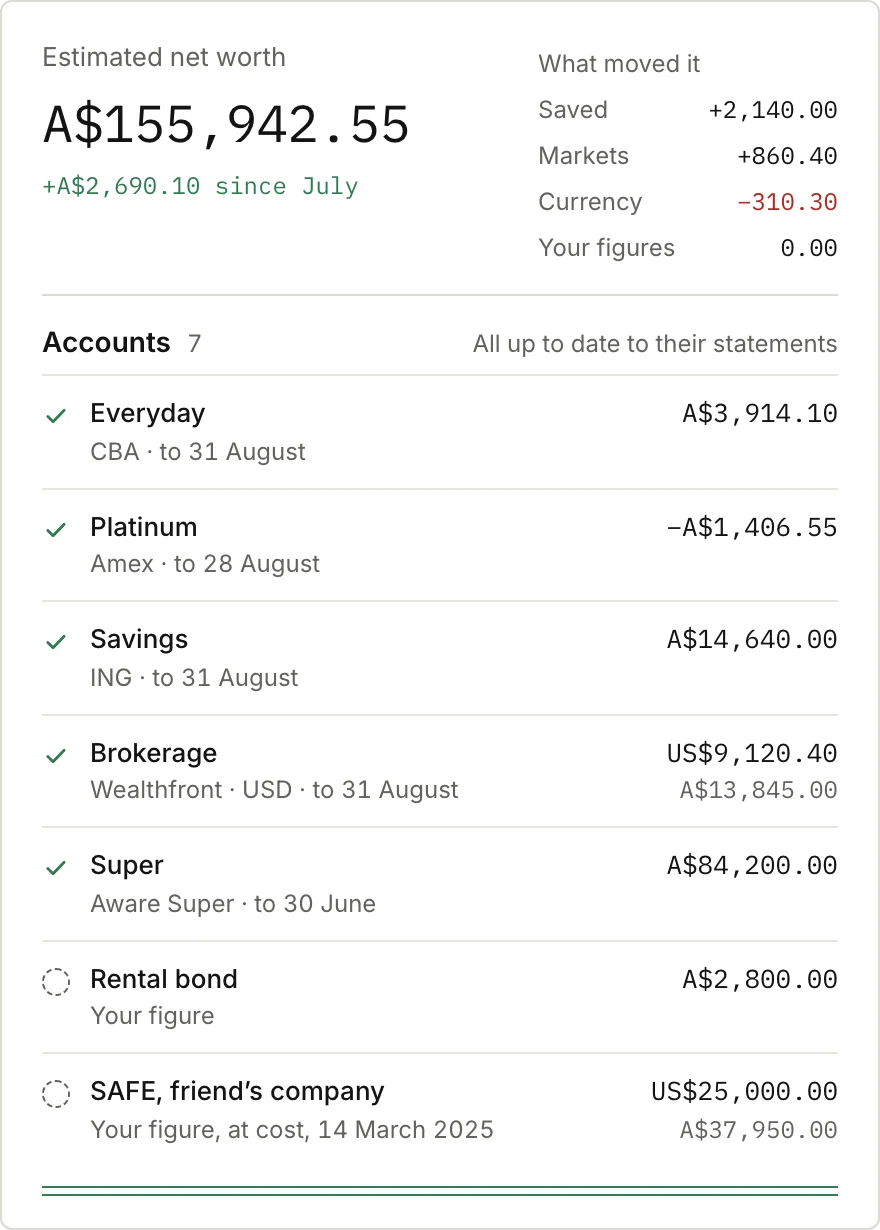
| What moved your net worth | If you build it | Every month split into saved, markets and currency, to the cent |
| Checks every account against your bank | Only if you do it | Every account, every month, to the cent |
| Australian banks | You type it in | Any bank or fund, from its statements |
| Price | Free, plus your evenings | A$10 a month or A$100 a year |
In cent4cent nobody types the month in or sorts it. The statements are read, every line is sorted, every account is matched to its statement, and a partner or accountant can open the book and follow it.
Bring last month in and see it without typing a thing. 14 days free, no card needed.